Cambridge International Professional Development Qualifications for Teachers (CICTL & CIDTL)
Learn Locally, Teach Globally.
Become an Internationally Certified Teacher Cambridge PDQ at RCOE

Your classroom, recognized by Cambridge
You already give your students your best every day. What if that effort earned you a qualification recognized across the world?
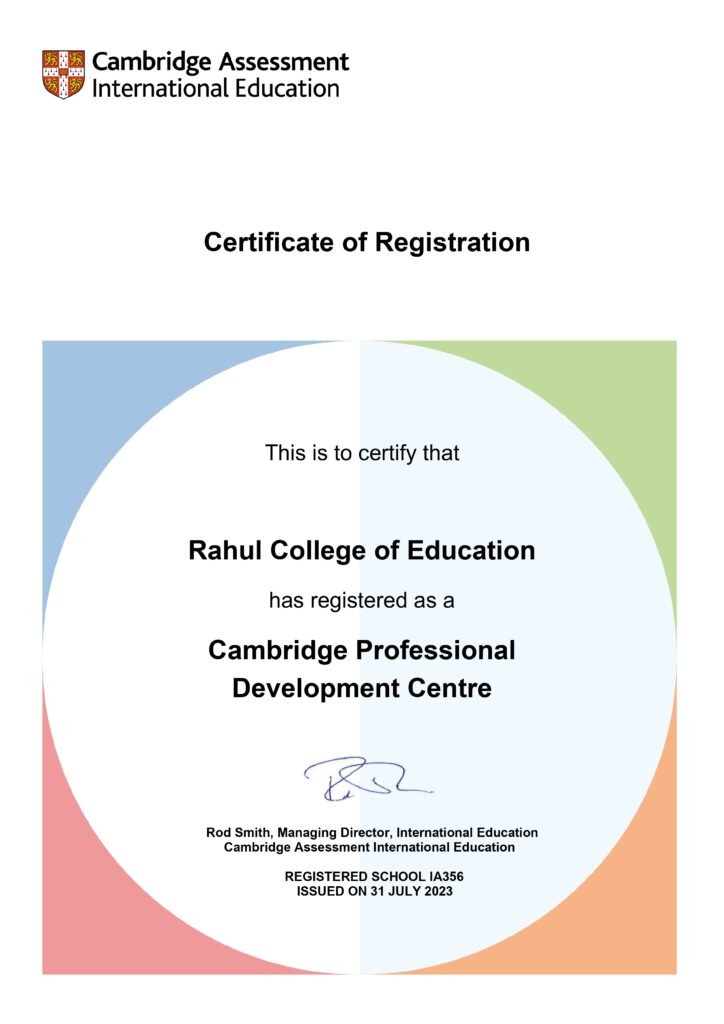
Rahul College of Education, Autonomous (RCOE), Mira Road, invites teachers to join the Cambridge Professional Development Qualifications (PDQ) – the Certificate (5881) and the Diploma (5882). Study from home, apply your learning in your own classroom and earn an International Accreditation from Cambridge.
Two Pathways, One Goal: Better Teaching
Cambridge PDQs are practice-based. You learn by teaching, reflecting and improving — not by memorizing theory for an exam.
| Programme | Best suited for | What you build |
|---|---|---|
| PDQ Certificate (5881) | New teachers and teachers taking their first formal step in professional development. | A strong base in planning, active learning, assessment and reflective practice. |
| PDQ Diploma (5882) | Experienced teachers ready to deepen and lead practice. | Advanced, research-informed practice and the confidence to guide colleagues. |
Every candidate is guided by a mentor and builds a portfolio of evidence drawn from their own lessons. RCOE offers both face-to-face and blended sessions, so the programme fits around a working teacher's timetable.
International professional development, closer to home
The Only Cambridge PDQ Centre from Dahisar to Virar
RCOE is the only Cambridge PDQ-accredited centre from Dahisar to Virar and across the Palghar region (Cambridge centre code IA356). Teachers in Mira Road, Bhayandar, Vasai, Nalasopara, Virar and Palghar no longer need to travel into the city for an international qualification.
- Accredited by Cambridge — the same standards as PDQ centres worldwide.
- Close to home — less commuting, more time for your classroom and family.
- Personal mentoring — small cohorts and regular one-to-one guidance.
- Flexible delivery — face-to-face and blended options.
- Backed by Rahul International School — a real school setting for practice and observation.
A PDQ Puts NEP 2020 into Practice
The National Education Policy 2020 asks Indian teachers to keep learning, teach for understanding and reflect on their practice. A Cambridge PDQ helps you work towards these goals — and demonstrate your development with evidence.
| What NEP 2020 asks of teachers | How the Cambridge PDQ helps |
|---|---|
| At least 50 hours of Continuous Professional Development (CPD) every year. | A structured, mentored programme that supports meaningful, documented professional development. |
| A shift from rote learning to conceptual, experiential and inquiry-based learning. | Active learning strategies planned, tried and refined in your own lessons. |
| Competency-based and formative assessment. | Practical work on assessment for learning, feedback and tracking progress. |
| Critical thinking, creativity and 21st-century skills in students. | Lesson design that builds questioning, collaboration and problem-solving. |
| Reflective, research-aware teachers. | Reflective practice and evidence-based teaching at the heart of the portfolio. |
| Merit-based career progression and professional standards (NPST). | A recognised qualification and a portfolio documenting your professional growth. |
| Inclusive and learner-centred classrooms. | Planning for diverse learners and differentiated instruction. |
In short, a PDQ helps turn the goals of NEP 2020 into daily classroom habits - while giving you an International Professional Qualification.
Who Should Join?
Cambridge PDQs are designed for educators who want to strengthen their practice, support their learners and continue growing professionally.
- Pre-primary teachers
- Primary teachers
- Secondary teachers
- Subject coordinators
- Aspiring school leaders
- Fresh graduates entering teaching
If you care about how your students learn, there is a place for you here.
What is the Qualification Structure?
The CIDTL course is designed to provide teachers with the knowledge and skills needed to enhance their teaching practice and improve learning outcomes for their students. The course consists of three modules:
| Module 1 |
| EXPLORING TEACHING & LEARNING [CERTIFICATE] |
| This module provides an overview of key ideas and starting points in new thinking and practice related to teaching and learning. The recommended duration for this module is 4 months, with 150 learning hours in preparation. |
| Module 2 |
| TEACHING & LEARNING IN ACTION [DIPLOMA] |
| This module focuses on the practical application of new thinking and practice related to teaching and learning. The recommended duration for this module is 4 months, with 150 learning hours in preparation. |
| Module 3 |
| DEVELOPING PROFESSIONAL PRACTICE[DIPLOMA] |
| This module focuses on the development of professional practice through a practitioner inquiry process. The recommended duration for this module is 4 months, with 150 learning hours in preparation. |
Assessment for each module involves the submission of a portfolio of evidence of practice, learning and reflection. The portfolio should demonstrate the teacher’s ability to apply new thinking and practice in their teaching and to reflect on their practice systematically and meaningfully. The evidence length required is 3600 words and should include work-based records.
Overall, the CIDTL course is designed to be completed within a 12-month period, with each module taking approximately 4 months to complete. However, the duration of the course may vary depending on individual learning needs and the pace of study.
What does the Certificate or Diploma involve?
A typical Certificate or Diploma programme run by a Cambridge Professional Development Centre consists of a broad balance of activities, appropriate to the needs and circumstances of teachers and their schools. The programme is planned by the centre’s programme leader and team as a coherent sequence of learning over time, with a variety of elements.
Teachers should integrate as much preparation time as possible into their day-to-day practice. They should allow time for background reading and discussion with their colleagues, to enrich their reflective practice. During each stage of the programme, teachers explore a number of key questions and engage in a series of activities closely related to their everyday professional work. These activities and related reflections
produce evidence for assessment. There is an important role for a mentor to play in supporting this learning. Through discussion and questioning skills, mentors encourage teachers to reflect on their learning and on what it means for their approaches to teaching. They also help teachers to demonstrate through examples and accounts of practice that they are:
• Acquiring new skills
• Learning how to use their new skills and knowledge
• Linking changes in classroom practice to improvements in student outcomes.

How are the Certificate and Diploma assessed?
Teachers are assessed through an ePortfolio of evidence, submitted to a team of Cambridge International examiners. In their portfolio, teachers demonstrate their knowledge, skills and understanding in the context of their own work. Portfolio evidence includes:
• observing a colleague’s classroom practice
• planning, teaching, learning and assessment materials that arise naturally out of the teaching process
• feedback from mentors, colleagues, students and others
• the candidate’s own reflections on their learning and practice.
Evidence Requirements
In their portfolio, teachers will use the relevant Cambridge International templates to gather, organise and present their evidence to satisfy the assessment criteria. In the introduction to the portfolio, teachers provide background information about their professional experience and role, and the context in which they teach. This is their opportunity to indicate significant influences on their work and professional development. Although the introduction is not formally assessed or judged, it does help the examiner to understand the teaching context and interpret the subsequent assessment evidence.
With written evidence, teachers should keep to the word limits and respond to the prompts in templates succinctly. The prompts indicate how to focus and shape explanations, reflections and other evidence. Teachers must also follow Cambridge International’s rules for the format and size of digital evidence, such as images and video. Teachers’ reflections should provide references for other people’s ideas and experiences, whether these are in the form of academic publications, or posts to online discussion forums or blogs. All sources must be clearly referenced.
Documents Required for Joining the course
• Academic and Professional Credentials
• Copy of your Appointment Letter (Current Institution Employed at)
• Aadhar Card Copy
• 3 Passport Size Photographs
Fee Structure of the course:
• Academic Fee: Rs. 50,000
Admissions Open · Cambridge PDQ
Take the Next Step in Your Teaching Career
Great teachers never stop learning. Make this the year your teaching earns international recognition.
Rahul College of Education (RCOE) Cambridge PDQ Centre · Shree. L.R.Tiwari Educational Campus, Mira Road Call / WhatsApp: 9226244705 Website: rahul-edr.org
Seats are limited to keep cohorts small. Connect with us today to book a counselling session and find the right PDQ pathway for you.
Book a Counselling Session →
‘Educationists should build the capacities of the spirit of inquiry, creativity, entrepreneurial and moral leadership among students and become their role model” by Dr. A.P J. Abdul Kalam.
Teachers must understand that they are the builders of society and that society can only be formed if students are proficient in their subjects. They must also educate students with a perspective of life and impart the principles of values that the students should follow in the years ahead.
Professional development can help teachers learn to cooperate, innovate, and reflect on their work.
The only way to become a successful and excellent educationist is to learn, unlearn, and relearn. As a result, one of the most important goals of the Rahul Group is to nurture and develop good and effective educators. Together we can, and we will make a difference in society.’
PROGRAM LEADER – MR. UTSAV TIWARI(COO)
Leave us your Info
and we will get back to you.